
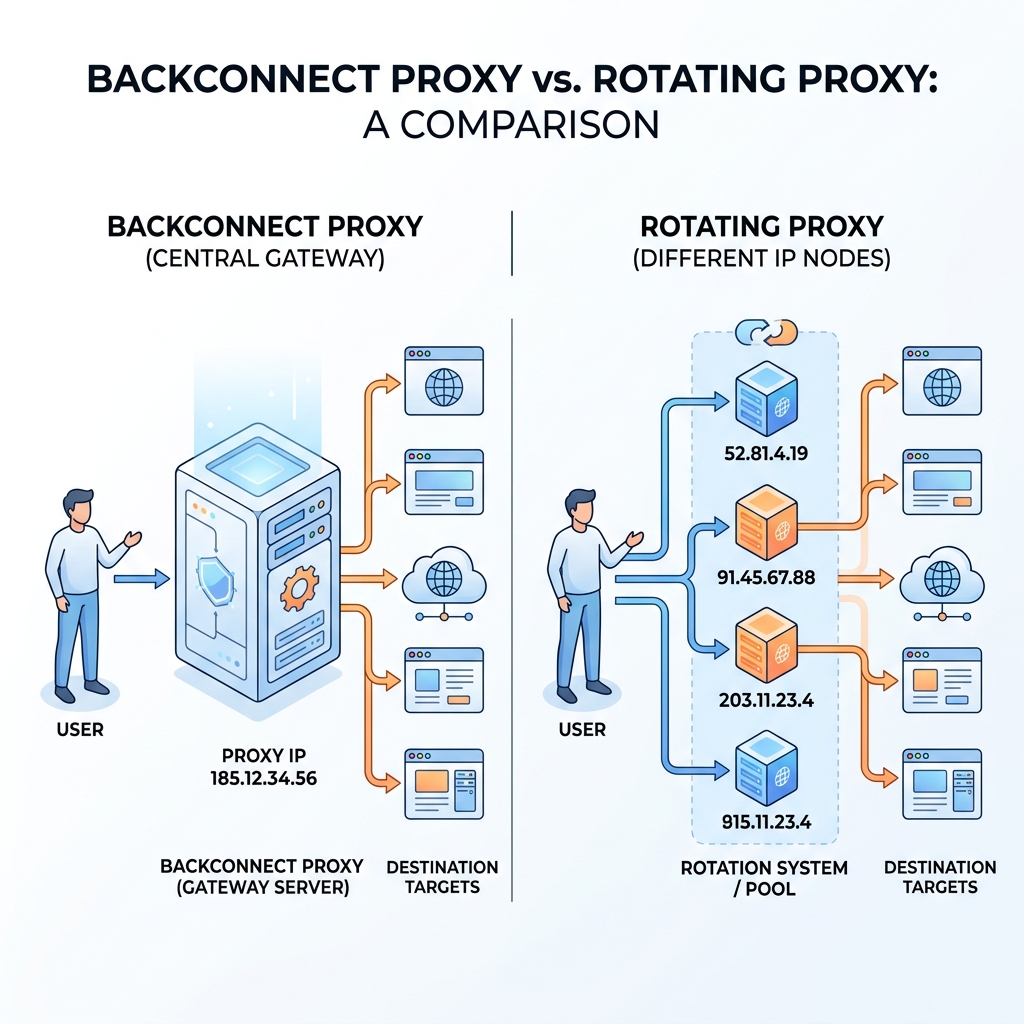
Stop Getting Blocked: Backconnect Proxy vs Rotating Proxy Truth
The Confusing Jargon of the Proxy Industry
If you have spent any time researching solutions for large-scale web scraping, SEO tracking, or social media management, you have probably run into terms like **backconnect proxy**, **rotating proxy**, and **backconnect rotating proxy**.
Many providers use these terms interchangeably, leaving developers and business owners confused. Are they the same thing? Which one actually stops target web platforms from blocking your bot? Let’s dissect the truth.
Defining the Mechanics
To understand the difference, we have to look at the protocol configuration vs the operational behavior.
1. Backconnect Proxy (The Architecture)
A backconnect proxy refers to the *underlying connection mechanism*. You connect to one central gateway (e.g., gate.turboproxy.com:1221), and the server "connects back" to its internal pool of IPs to route your traffic. This means you do not have to manage a list of individual IP addresses in your program.
2. Rotating Proxy (The Behavior)
A rotating proxy refers to the *action* of changing the IP address. This can happen per-request, or on a timer (e.g., every 5, 10, or 30 minutes). You can rotate proxies using a local script, but it is slow and resource-heavy.
A backconnect rotating proxy combines both of these concepts: it is a single gateway that automatically handles rotation dynamically on the backend server.
Why You Need a Backconnect Rotating Proxy
Traditional scrapers that do not use a backconnect gateway are highly inefficient. If you manually cycle through a text file list of 1,000 proxies, you have to handle connection timeouts, dead proxies, and proxy-specific authentication errors inside your own codebase.
With a dedicated backconnect rotating proxy gateway:
- Dead IPs are Automatically Filtered: If a proxy in the pool goes offline, the backconnect gateway detects it instantly and routes your connection to a fresh, active IP without returning an error to your application.
- Massive Concurrent Requests: You can send hundreds of scraper threads simultaneously, and each thread will automatically get a different IP address, maximizing speed.
- SOCKS5 and HTTP/S Support: Fully compatible with modern automation tools (Puppeteer, Selenium, Playwright, Scrapy) using credential verification.
Comparison: Backconnect vs. Standard Proxy List
| Feature | Backconnect Rotating Proxy | Standard Proxy List |
|---|---|---|
| Configuration | 1 host/port setup | Requires script logic to cycle IPs |
| IP Pool Access | Millions (Dynamic pool) | Limited to purchased IPs |
| Uptime Management | Automatic failover | Manual error handling in code |
Get Ultimate Rotation Control
Unlock access to the world's most stable backconnect rotating proxy network. Avoid IP bans, bypass CAPTCHAs, and scale your operations today.