
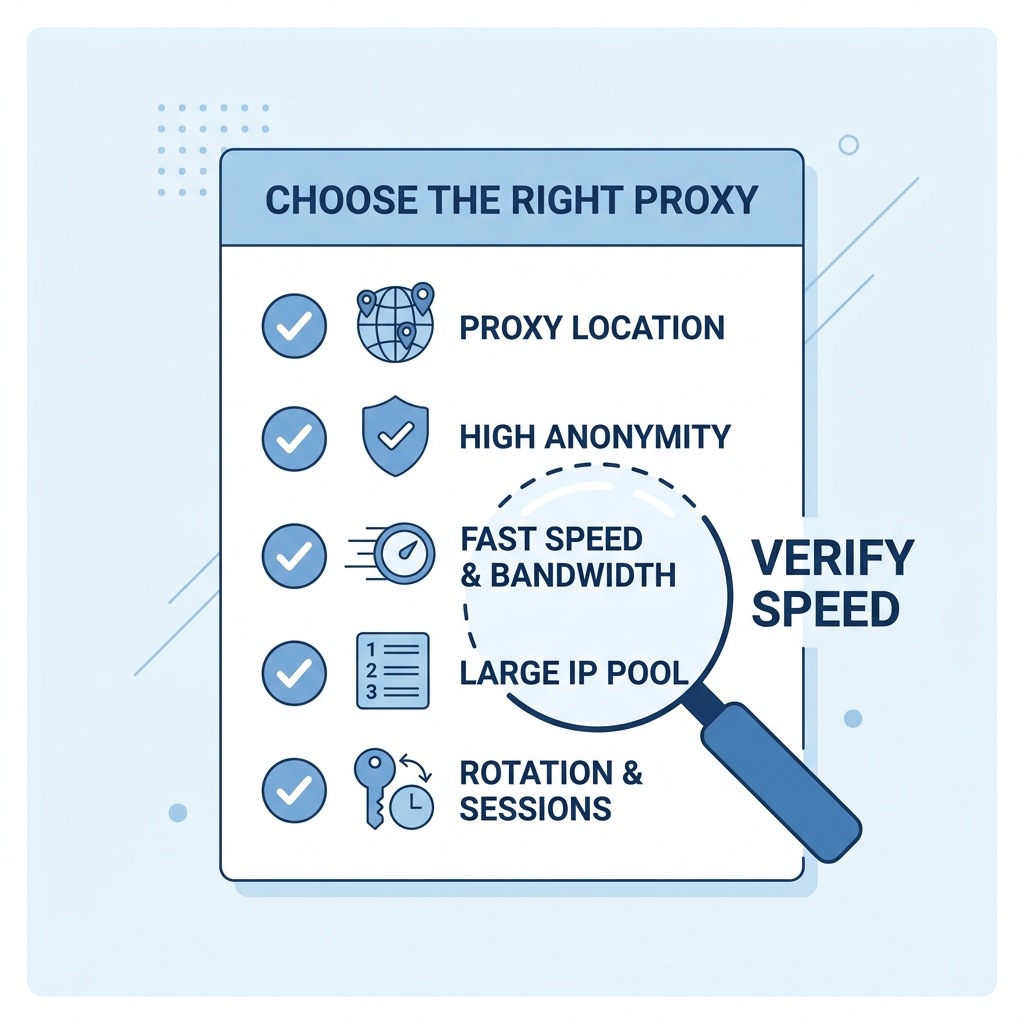
Choosing the Right Proxy: Ultimate Buyer's Guide
Table of Contents
Introduction
The proxy market is filled with various providers, each promising the fastest speeds, largest IP pools, and lowest block rates. However, choosing the right provider is not always straightforward. A service that is ideal for ad verification might be too expensive or slow for bulk e-commerce scraping.
To choose the right option for your projects, you need to evaluate key technical parameters like pool architecture, IP reputation, protocol support, and cost efficiency. This guide covers everything you need to know.
1. Pool Size and Geo-distribution
The size of a provider's IP pool directly impacts your success rate. A larger pool means:
- Lower IP Reuse: Reduces the chance of using an IP address that has already been flagged by your target website.
- Better Geo-targeting: Allows you to target specific countries, states, and cities for localized tasks.
- Scalability: Supports running multiple concurrent threads without hitting pool limits.
2. Ethical Sourcing Policies
Ethical IP sourcing is critical for business compliance. Reputable providers acquire residential IPs transparently through SDK integrations, where users opt-in and are compensated for sharing their bandwidth.
Avoid providers that build their pools through malware or hidden software. Using unethically sourced pools increases your compliance risk and can lead to legal issues.
3. Connection Protocols (SOCKS5 vs HTTP)
Verify that the provider supports modern connection protocols:
- HTTP/HTTPS: Best for standard web scraping and API calls.
- SOCKS5: Offers better performance for UDP traffic, streaming, and custom TCP connections. It provides faster handshakes and is ideal for complex scraping tasks.
4. Provider Evaluation Checklist Table
Use this checklist to evaluate potential proxy providers:
| Criteria | Questions to Ask | Target Value |
|---|---|---|
| Pool Capacity | How many active IPs are available daily? | > 1 Million residential IPs |
| Geo-targeting | Can I target state, city, and ISP levels? | Yes (included by default) |
| API Features | Do they offer programmatic configuration endpoints? | Yes (with simple docs) |
| Support Service | What support options are available? | Dedicated Telegram support |
5. Comparison Table: Premium Pools vs. Public Pools
Why you should avoid using lists from our free public proxy list for critical business applications:
| Metric | Premium Providers (Turbo Proxy) | Free/Public Lists |
|---|---|---|
| Uptime SLA | 99.9% Uptime Guarantee | < 10% Uptime (highly unstable) |
| Response Speeds | Fast (< 300ms latency) | Extremely slow (> 5000ms latency) |
| Security Risk | Clean, encrypted connections | High risk of data interception |
| Block Rates | Low block rates (high trust IPs) | Almost 100% blocked on major sites |
6. Success Rates and Latency
Evaluate providers through a trial or test period. Measure:
- Request Success Rate: The percentage of requests that complete without errors. Aim for >99% on target sites.
- Average Latency: The time it takes to receive a response. High latency can slow down your scraping tasks.
7. Understanding Billing Models
Proxy pricing models typically fall into two categories:
- Pay-Per-GB (Residential/Mobile): Best for small-to-medium scraping tasks, as you only pay for the bandwidth you consume.
- Flat-Rate-Per-IP (Datacenter): Best for high-bandwidth tasks, offering unlimited usage for a fixed monthly cost.
Frequently Asked Questions
How do I check the reputation of a proxy provider?
Look for providers that offer large pools (millions of IPs), clear ethical sourcing disclosures, SOCKS5 support, and a high-availability uptime guarantee.
What is the advantage of pay-per-GB pricing?
Pay-per-GB pricing is highly cost-effective because you only pay for the actual bandwidth you consume, rather than renting fixed monthly IPs that might get blocked.
Why are public or free proxy lists dangerous?
Free proxies have no security encryption, are often monitored by malicious actors to capture user data, and are almost instantly blacklisted by all major websites.
Conclusion
Choosing the right proxy provider (see our complete datacenter vs residential comparison) involves balancing trust, performance, SOCKS5 support, and cost. Learn more about ISP trust scores in our guide on why to use residential proxies.
Ready to deploy high-reputation proxies? Turbo Proxy offers over 7 million residential, mobile, and datacenter IPs with 99.9% uptime. Sign up today and get started.